Surplus Capital Assets vs. Inventory
What's the Difference?
Enterprises confuse surplus with inventory because both sit in storage. That is a surface similarity. One is a planned operating asset; the other is displaced capital.
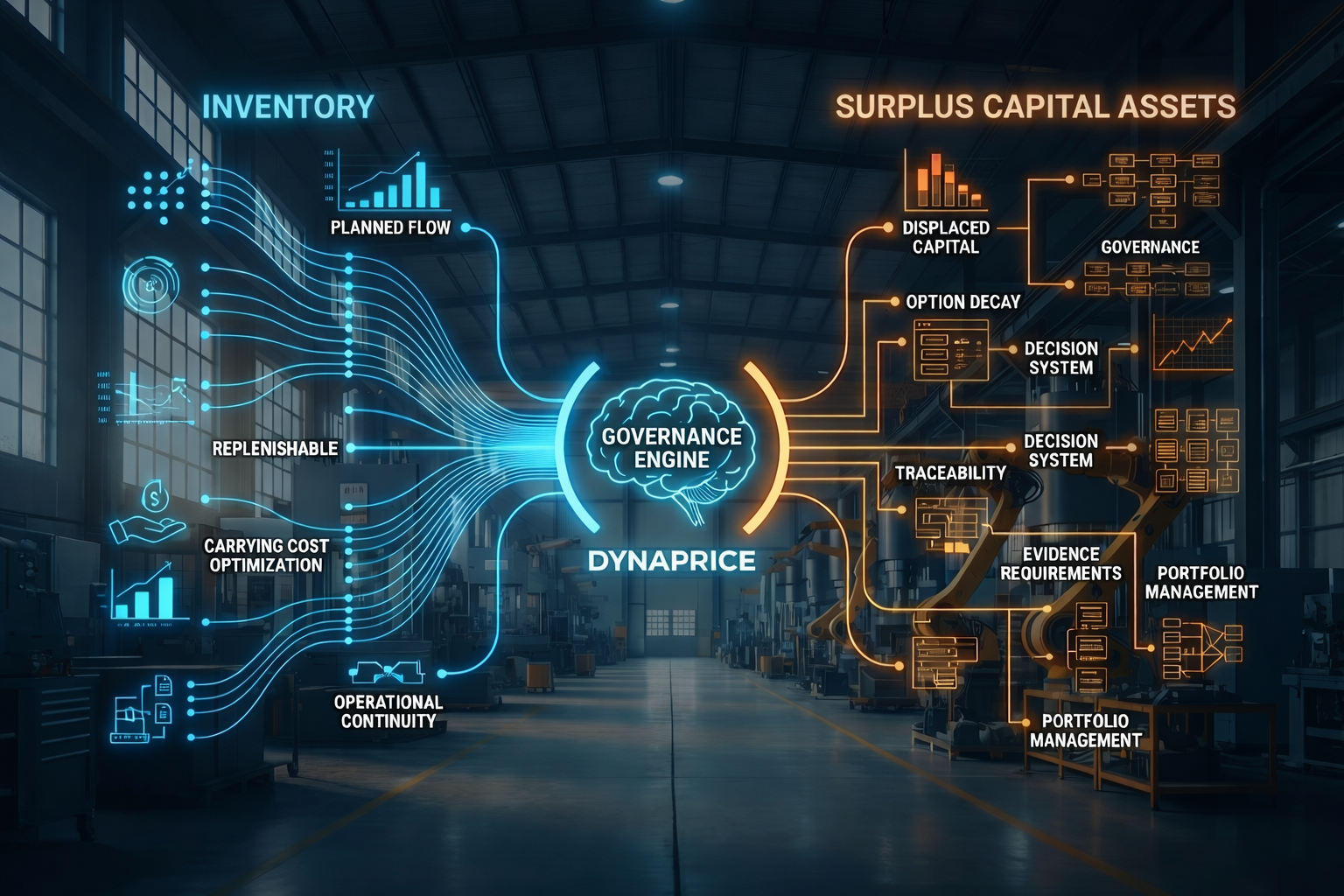
The Governance Engine bridges the gap between planned flow and displaced capital.
Flow System vs. Decision System
This distinction matters because it changes the governing logic. Inventory is governed by replenishment; Surplus is governed by outcomes.
Inventory
Is a Flow System
Inventory exists because the enterprise intends to consume it. It is reversible, replenishable, and expected.
- Stock Levels
- Demand Forecasting
- Reorder Points
- Carrying Cost Optimization
- Supplier Performance
Governing Question:
"When do we reorder?"
Surplus
Is a Decision System
Surplus appears when an asset exits primary use. It is an interruption: high value, condition-dependent, and compliance-sensitive.
- Outcome Logic
- Condition Dependent
- Compliance Sensitive
- Logistics Constrained
- Irreversible Decisions
Governing Question:
"What outcome path should we choose?"
Why Mislabeling Creates Loss
When surplus is treated like inventory, enterprises apply the wrong mechanisms. They optimize storage instead of decisions.
Assets sit longer because holding feels harmless.
Redeployment fails because receiving sites cannot trust the condition.
Recovery suffers because channel and timing decisions are late.
The Failure Mode
Carrying Cost vs. Option Decay
Inventory economics centers on carrying cost—accumulating gradually. Surplus economics centers on Option Decay—value loss that can be sudden and total.
- A market window closes.
- A model becomes unsupported.
- A facility schedule forces removal.
- A compliance deadline triggers scrapping.
Traceability vs. Availability
Inventory is controlled through availability—having the right item at the right time. Surplus is controlled through traceability.
The enterprise must be able to prove identity, condition, ownership, and authorization because surplus outcomes intersect with audit, environmental rules, and export controls.
> Asset_ID: REQ-8842
> Condition_Proof: VERIFIED
> Ownership_Chain: VALID
> Env_Compliance: PENDING_REVIEW
// Surplus moves through exception pathways unless standards are designed.
What Enterprises Should Do Instead
Treat surplus capital assets as a portfolio, not a pile. This is not an inventory program. It is a governance program.
Stop Storing Capital. Start Managing It.
Confusing inventory and surplus produces delayed decisions, higher risk, and lower recovery. Apply the right discipline today.